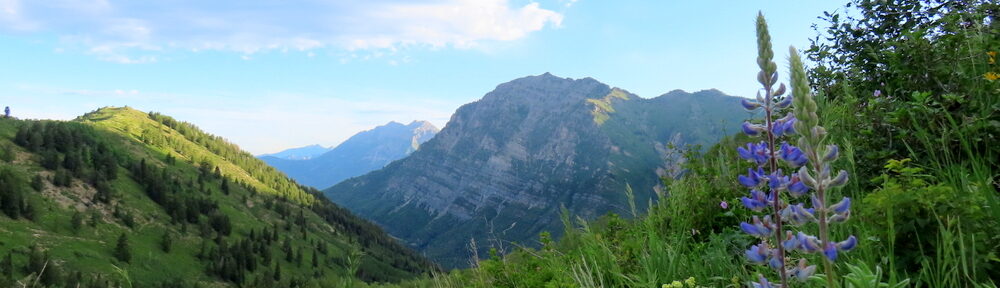
With my friend Chris back in the U.S. for a short while, and after having spent the weekend with a bunch of friends in the San Rafael Swell, I took Monday through Wednesday off work and he and I hiked each day. We sat down in front of my computer with Google Earth open and he picked a couple of trips that I had partially mapped out. We initially had a different trip in mind for Monday but then I checked the weather and decided with a chance of rain that we’d defer that trip until Tuesday and go to Nine Mile Canyon instead–a paved road sounded more pleasant than 50+ miles of potentially sloppy dirt roads. First we hiked up a side canyon to see a nice pictograph panel that I’d been to once before. We went farther up the canyon than I’d been on that previous trip and saw a little more rock art, and a cool inscription by A. Ostergaard from 1917. We’d had to leap across Nine Mile Creek on the way there, and on the return trip Chris missed the landing and got a little bit wet.
Red and white pictographs

Bighorn sheep and human figures

Ute petroglyphs

A. Ostergaard, 6/5-1917, Age 19

Blue sky and sagebrush

Pictographs overhead

Cow crap

W.B.

Jumping Nine Mile Creek

Next we stopped to explore some high cliffs and ledges where I’d spotted some good rock art from the road two and a half years earlier. As is often the case in Nine Mile, once we got to the rock art that’s visible from the road we encountered more and more as we scrambled around. Throughout the various cliff bands in this area were human figures with an unusual circle-head motif. We spent nearly two hours just climbing around this one spot.
Climbing up to the cliffs

Six-fingered figure

4×5 toes

Hands-up horned figure

Spirals

Ledge panel

Ledge panel zoom

The first of the circle-head motifs we encountered

More circle-heads

Circle-heads with more recent pecking

Small animal and human figures

Climbing higher around a corner

Another circle-head

Lichen-covered sheep

Turkey

Alien panel

Aliens

Small purple flowers

Burden bearers or hunchbacks

Unfinished bear track petroglyphs

One-armed figure

Horned figure

A big W

We moved down the road a short distance and climbed up to some more rock art I’d taken note of on a previous trip, spending another hour in one small area.
Panel below an overhang
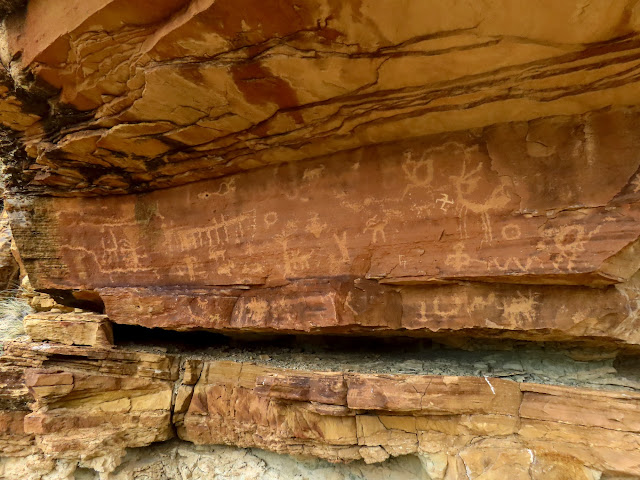
Light-colored pictographs

Petroglyphs

Faded and dirt-covered panel

Long connected sheep, canine, and deer

Animal with bird tracks

Pictos and glyphs

Remains of some rock walls

Lines

Burden bearers or hunchbacks

Long zig-zag

Footprint panel

Pigskin panel

Our final stop yielded some interesting finds. We’d just been driving down the road and pointing binoculars at any spots that had good potential when I noticed some petroglyphs up high. It didn’t necessarily look possible to climb up to them but we gave it a try, and were surprised to find some moqui steps carved into a narrow ramp leading to the rock art. Behind some boulders there was more rock art not visible from below.
High-up ledge with petroglyphs

Moqui steps carved into a ramp

View down from above the ramp

Weathered horned figure
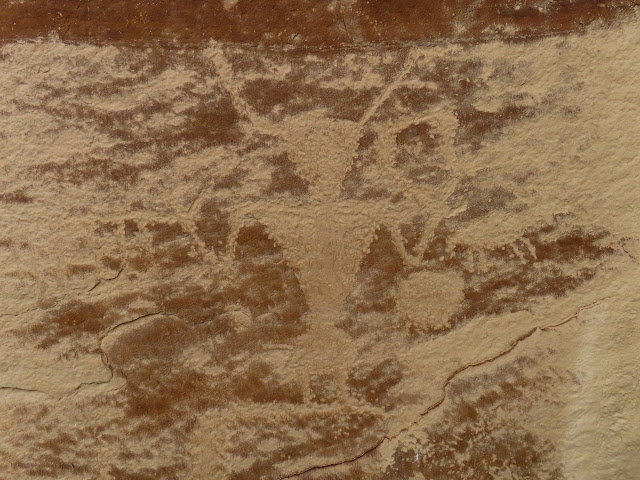
The small panel I’d seen from below

A nice panel that was hidden behind boulders

Fine details on this little horned guy
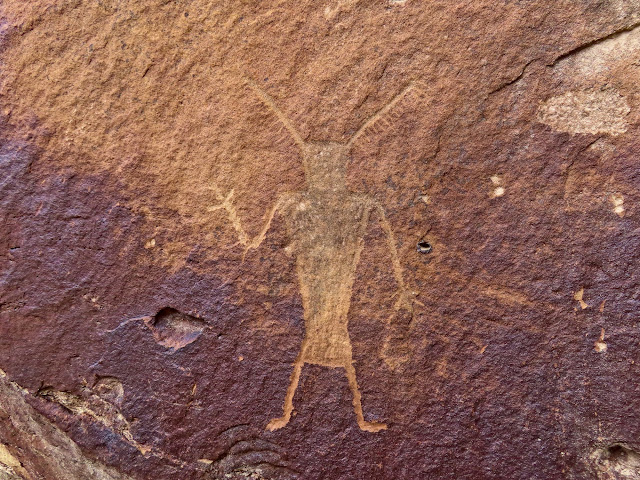
Wavy line figure

Dick and a box

The ledge we were on tapered away to nothing and we couldn’t continue further, but across the small side canyon was another ledge at the same level where I could see some stone structures. We clambered back down the moqui step ramp and to the road and scouted a way up to the ledge with the structures but we didn’t have time to confirm the route would go because my wife was expecting us home for dinner. We decided to return in a couple of days to give it a go.
Interesting ledge across the canyon

Structures on the ledge

Photo Gallery: Willkommen Zurück Part 1: Nine Mile Canyon